




A library for your API that provides:
- Automated Integration Testing
- Automated Live Documentation
Given an API specification, written in YAML/JSON format, ScanAPI hits the specified endpoints, runs the test cases, and generates a detailed report of this execution - which can also be used as the API documentation itself.
With almost no Python knowledge, the user can define endpoints to be hit, the expected behavior for each response and will receive a full real-time diagnostic report of the API!
- Quick Start
- Documentation
- Tutorial
- Examples
- Dependency Management
- Contributing
- Contributors
- Supporters Through Time
$ pip install scanapiIf pip install scanapi collides with the dependencies in your project's environment, install it with pipx instead. pipx gives ScanAPI its own virtual environment and still puts the scanapi command on your PATH:
$ pipx install scanapiThis is the recommended path when you want ScanAPI as a standalone CLI rather than a project dependency.
You will need to write the API's specification and save it as a YAML or JSON file. For example:
endpoints:
  - name: scanapi-demo # The API's name of your API
    path: http://demo.scanapi.dev/api/v1 # The API's base url
    requests:
      - name: list_all_users # The name of the first request
        path: users/ # The path of the first request
        method: get # The HTTP method of the first request
        tests:
          - name: status_code_is_200 # The name of the first test for this request
            assert: ${{ response.status_code == 200 }} # The assertion
And run the scanapi command
$ scanapi run <file_path>Then, the lib will hit the specified endpoints and generate a scanapi-report.html file with the report results.


The full documentation is available at scanapi.dev
Get started with ScanAPI by following our step-by-step tutorial.
You can find complete examples at scanapi/examples!
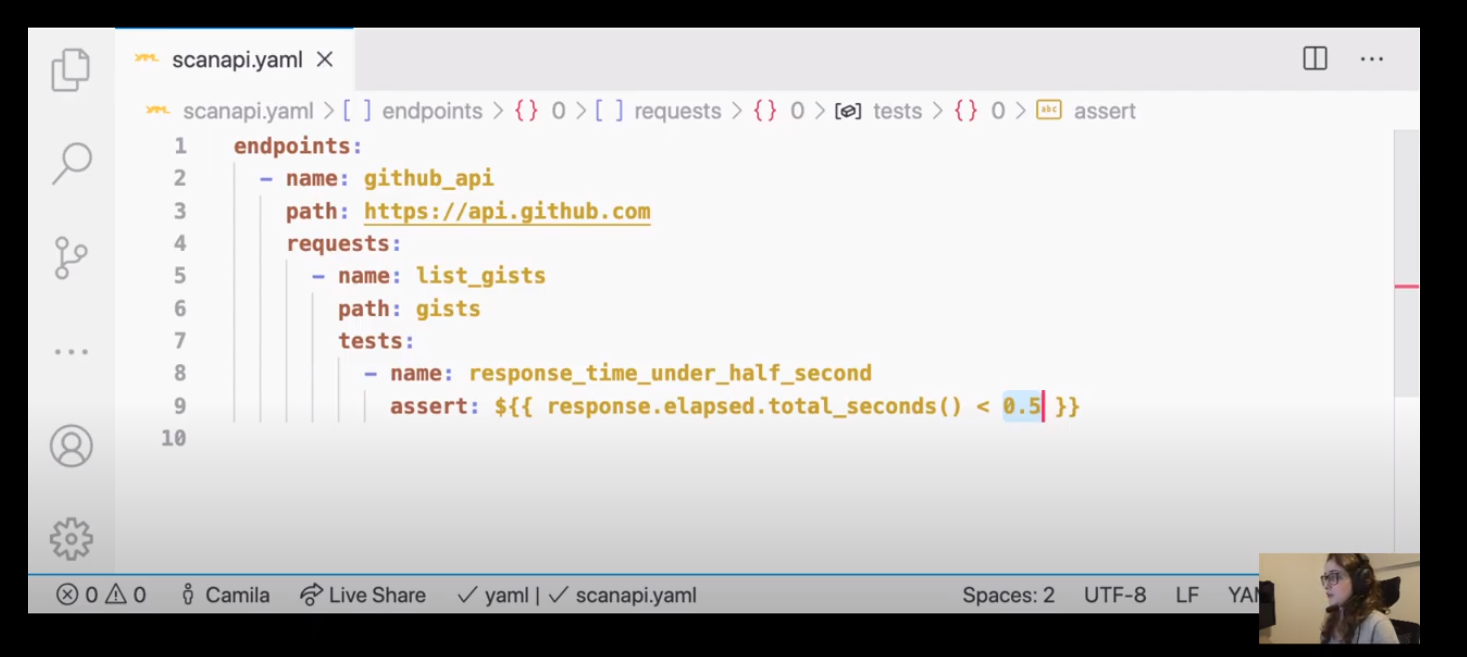
This tutorial helps you to create integration tests for your REST API using ScanAPI
ScanAPI aims to minimize dependency conflicts and ensure a smooth developer experience. Most dependencies are specified as compatible version ranges to allow flexibility and avoid unnecessary conflicts. However, a few dependencies are strictly pinned for stability:
- MarkupSafe==3.0.3: Pinned to the latest version for security and compatibility. Relax if future versions are verified safe.
- pytest-freezegun==0.4.2: This package is unmaintained and only 0.4.2 is available. Strict pin is required for test stability.
- requests-mock==1.12.1: Pinned to the latest version for compatibility. Relax if future versions are verified safe.
All other dependencies use safe version ranges (e.g., >=X.Y,<X+1.0) to reduce the likelihood of dependency conflicts. If you encounter issues with dependency installation, please open an issue or PR.
Dependency updates are regularly reviewed to ensure compatibility with supported Python versions and CI stability.
Collaboration is super welcome! Check out our contribution guide to get started. Every little bit of help counts! Feel free to create new GitHub issues and interact here.
Let's build it together 🚀🚀
Made with contrib.rocks.

