Inside (C)Python
Tom Lee @tglee

 OSCON 2012
19th July, 2012
Overview

• About   me!
 • Implemented unified try/except/finally for Python 2.5 (Georg Brandl’s PEP 341)
 • Support for compiling ASTs to bytecode from within Python programs for 2.6
 • Wannabe compiler nerd.

• Terminology    & brief intro to compilers:
 • Grammars, Scanners & Parsers
 • Parse Trees & Abstract Syntax Trees
 • General architecture of a bytecode compiler

• How   to add new syntax to Python:
 • Python compiler architecture & summary
 • Case study in adding a new keyword
 • Demo!
“Python” vs. “CPython”

• When    I say “Python” in this presentation, I mean CPython.
• Other   Python implementations:
 • Jython
 • PyPy
 • IronPython
 • Stackless Python
 • More...

• Many    of the concepts here are likely applicable, but the details may differ wildly
• Refer   to the slides for my Inside PHP presentation to see how things may differ.
• Python   3.x
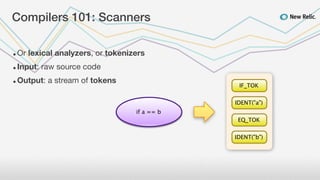
Compilers 101: Scanners

• Or   lexical analyzers, or tokenizers
• Input:   raw source code
• Output:   a stream of tokens
                                                 IF_TOK


                                                IDENT("a")
                                    if a == b
                                                 EQ_TOK


                                                IDENT("b")
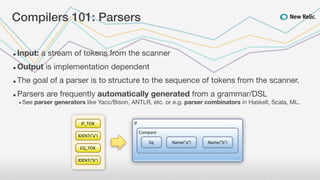
Compilers 101: Parsers

• Input:   a stream of tokens from the scanner
• Output     is implementation dependent
• The    goal of a parser is to structure to the sequence of tokens from the scanner.
• Parsers    are frequently automatically generated from a grammar/DSL
 • See   parser generators like Yacc/Bison, ANTLR, etc. or e.g. parser combinators in Haskell, Scala, ML.


                         IF_TOK              If

                                                  Compare
                        IDENT("a")
                                                      Eq    Name("a")   Name("b")
                         EQ_TOK


                        IDENT("b")
Compilers 101: Context-free grammars

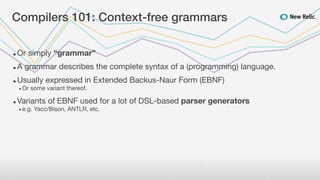
• Or   simply “grammar”
•A   grammar describes the complete syntax of a (programming) language.
• Usually     expressed in Extended Backus-Naur Form (EBNF)
 • Or   some variant thereof.

• Variants    of EBNF used for a lot of DSL-based parser generators
 • e.g.   Yacc/Bison, ANTLR, etc.
Compilers 101: Parse Tree


• Or     concrete syntax tree.
• “...
    an ordered, rooted tree that represents the [full] syntactic structure of a string
 according to some formal grammar.”
  • http://en.wikipedia.org/wiki/Parse_tree

• Python’s     parser constructs a parse tree based on Grammar/Grammar
  • Must   be manually converted to Abstract Syntax Tree before we do anything fun.
Compilers 101: Abstract Syntax Tree

• AST

• Rooted     tree data structure.
• In-memory,       intermediate representation of the input (source) program.
 • “Abstract”   in that it doesn’t necessarily include every detail that appears in the real syntax.

•A   code generator can traverse an AST and emit target code.
 • e.g.   Python byte code
                                                                    If
• Certain
        optimizations are also convenient at
 the AST level.                                                          Compare

                                                                             Eq      Name("a")         Name("b")
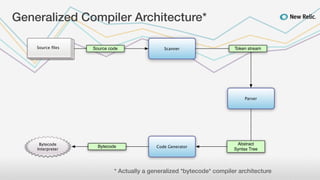
Generalized Compiler Architecture*

    Source files   Source code                Scanner                  Token stream


                                                                           Parser


     Bytecode                                                          Abstract
                    Bytecode              Code Generator
    Interpreter                                                       Syntax Tree


                           * Actually a generalized *bytecode* compiler architecture
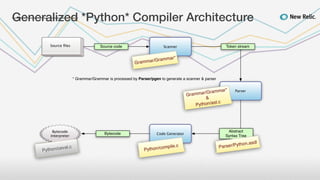
Generalized *Python* Compiler Architecture

         Source files                 Source code                       Scanner                            Token stream


                                                                rammar*
                                                       Grammar/G


                       * Grammar/Grammar is processed by Parser/pgen to generate a scanner & parser

                                                                                                      r*
                                                                                             /Gramma           Parser
                                                                                    Grammar
                                                                                              &
                                                                                                   .c
                                                                                        P ython/ast


          Bytecode                                                                                         Abstract
                                       Bytecode                    Code Generator
         Interpreter                                                                                      Syntax Tree

                                                                                                       arser/Py thon.asdl
           n/ceval.c                                        Python/compile.c                          P
     Pytho
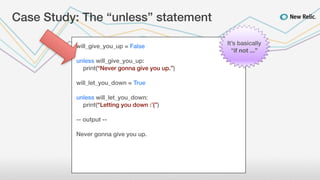
Case Study: The “unless” statement

                                                It’s basically
          will_give_you_up = False
                                                  “if not ...”
          unless will_give_you_up:
            print(“Never gonna give you up.”)

          will_let_you_down = True

          unless will_let_you_down:
            print(“Letting you down :’(”)

          -- output --

          Never gonna give you up.
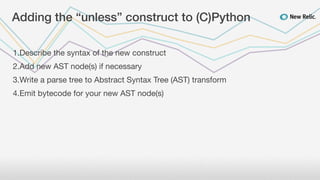
Adding the “unless” construct to (C)Python

1.Describe the syntax of the new construct
2.Add new AST node(s) if necessary
3.Write a parse tree to Abstract Syntax Tree (AST) transform
4.Emit bytecode for your new AST node(s)
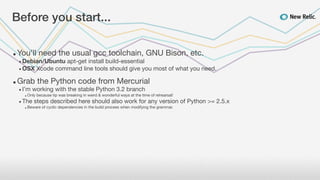
Before you start...

• You’ll      need the usual gcc toolchain, GNU Bison, etc.
  • Debian/Ubuntuapt-get install build-essential
  • OSX Xcode command line tools should give you most of what you need.

• Grab       the Python code from Mercurial
  • I’m   working with the stable Python 3.2 branch
    • Only   because tip was breaking in weird & wonderful ways at the time of rehearsal!
  • The   steps described here should also work for any version of Python >= 2.5.x
    • Beware   of cyclic dependencies in the build process when modifying the grammar.
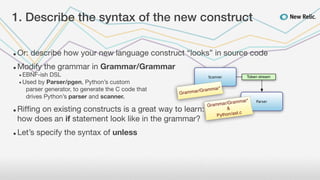
1. Describe the syntax of the new construct

• Or:   describe how your new language construct “looks” in source code
• Modify    the grammar in Grammar/Grammar
 • EBNF-ish  DSL                                               Scanner         Token stream
 • Used by Parser/pgen, Python’s custom
    parser generator, to generate the C code that            rammar*
                                                    Grammar/G
    drives Python’s parser and scanner.
                                                                         rammar*   Parser
                                                              Grammar/G
• Riffing
       on existing constructs is a great way to learn:                 &
                                                                             .c
                                                                  P ython/ast
 how does an if statement look like in the grammar?
• Let’s   specify the syntax of unless
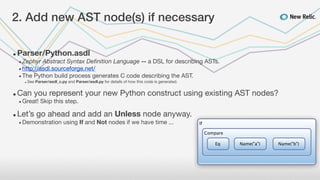
2. Add new AST node(s) if necessary

• Parser/Python.asdl
 • Zephyr Abstract Syntax Definition Language                         -- a DSL for describing ASTs.
 • http://asdl.sourceforge.net/
 • The Python build process generates C code                         describing the AST.
   • See   Parser/asdl_c.py and Parser/asdl.py for details of how this code is generated.


• Can   you represent your new Python construct using existing AST nodes?
 • Great!    Skip this step.

• Let’s    go ahead and add an Unless node anyway.
 • Demonstration          using If and Not nodes if we have time ...                        If

                                                                                                 Compare

                                                                                                     Eq    Name("a")   Name("b")
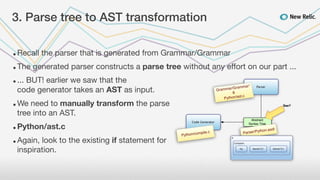
3. Parse tree to AST transformation

• Recall   the parser that is generated from Grammar/Grammar
• The   generated parser constructs a parse tree without any effort on our part ...
• ...
   BUT! earlier we saw that the
                                                                                            *
                                                                                    Grammar
 code generator takes an AST as input.                                             /                    Parser
                                                                          Grammar
                                                                                    &
                                                                                         .c
                                                                              P ython/ast

• We need to manually transform the parse                                                                                See?

 tree into an AST.
                                                                                                    Abstract
                                                        Code Generator

• Python/ast.c
                                                                                                   Syntax Tree
                                                                                                                     l
                                                              pile   .c                         Parser/P ython.asd
                                                  Py thon/com

• Again,look to the existing if statement for                                     If

                                                                                       Compare


 inspiration.                                                                              Eq        Name("a")   Name("a")
4. Emit bytecode for the new AST node

• This   step is only necessary if you added a new AST node in step 2.
• At   this point our AST is ready to compile to bytecode.
• Traverse    the tree, emitting bytecode as we go.
• What    bytecode instructions do we need to use?
 • What   does the bytecode for a simple if statement look like? How would we modify it?
Intermission: Python VM + bytecode
                                                                       data = []

• Python     has a stack based virtual machine.                        def push(x):
                                                                         data.append(x)
• Values     get pushed onto a data stack.
                                                                       def pop():
• Opcodes       manipulate the stack.                                    return data.pop()
 • e.g.   binary op: pop two values, compute result, push new value.
                                                                       def add():
• Control     flow using unconditional & conditional jumps.               push(pop() + pop())

                                                                       def sub():
                                                                         push(pop() - pop())

                                                                       push(5)      # [5]
                                                                       push(6)      # [5, 6]
                                                                       add()        # [11]
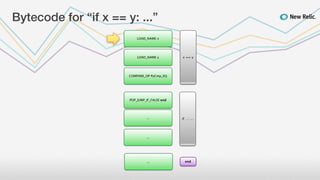
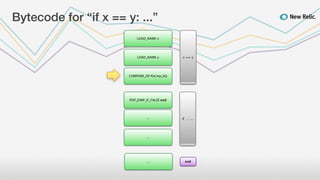
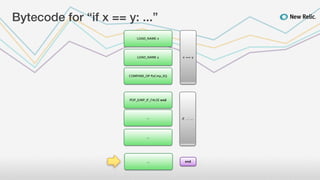
Bytecode for “if x == y: ...”
                           LOAD_NAME x


                           LOAD_NAME y         x == y


                       COMPARE_OP PyCmp_EQ


                       POP_JUMP_IF_FALSE end


                                ...            if …: ...


                                ...


                                ...              end
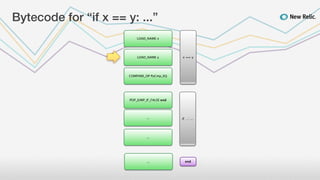
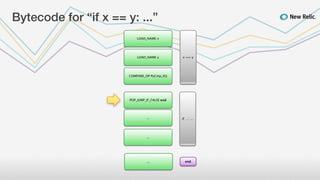
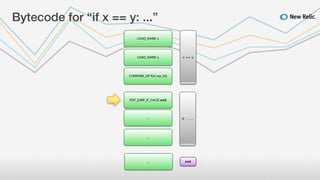
Bytecode for “if x == y: ...”
                           LOAD_NAME x


                           LOAD_NAME y         x == y


                       COMPARE_OP PyCmp_EQ


                       POP_JUMP_IF_FALSE end


                                ...            if …: ...


                                ...


                                ...              end
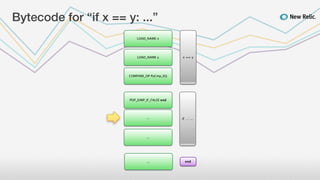
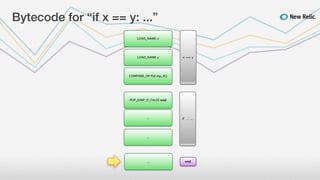
Bytecode for “if x == y: ...”
                           LOAD_NAME x


                           LOAD_NAME y         x == y


                       COMPARE_OP PyCmp_EQ


                       POP_JUMP_IF_FALSE end


                                ...            if …: ...


                                ...


                                ...              end
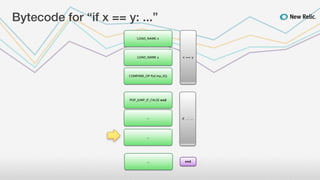
Bytecode for “if x == y: ...”
                           LOAD_NAME x


                           LOAD_NAME y         x == y


                       COMPARE_OP PyCmp_EQ


                       POP_JUMP_IF_FALSE end


                                ...            if …: ...


                                ...


                                ...              end
Bytecode for “if x == y: ...”
                           LOAD_NAME x


                           LOAD_NAME y         x == y


                       COMPARE_OP PyCmp_EQ


                       POP_JUMP_IF_FALSE end


                                ...            if …: ...


                                ...


                                ...              end
Bytecode for “if x == y: ...”
                           LOAD_NAME x


                           LOAD_NAME y         x == y


                       COMPARE_OP PyCmp_EQ


                       POP_JUMP_IF_FALSE end


                                ...            if …: ...


                                ...


                                ...              end
Bytecode for “if x == y: ...”
                           LOAD_NAME x


                           LOAD_NAME y         x == y


                       COMPARE_OP PyCmp_EQ


                       POP_JUMP_IF_FALSE end


                                ...            if …: ...


                                ...


                                ...              end
Bytecode for “if x == y: ...”
                           LOAD_NAME x


                           LOAD_NAME y         x == y


                       COMPARE_OP PyCmp_EQ


                       POP_JUMP_IF_FALSE end


                                ...            if …: ...


                                ...


                                ...              end
Bytecode for “if x == y: ...”
                           LOAD_NAME x


                           LOAD_NAME y         x == y


                       COMPARE_OP PyCmp_EQ


                       POP_JUMP_IF_FALSE end


                                ...            if …: ...


                                ...


                                ...              end
4. Emit bytecode for the new AST node (cont.)

• Python/compile.c
 • Look   for <AST>_kind to track down existing impls for AST nodes -- e.g. ClassDef_kind for classes

• Once    again: how is if implemented?
 • Look   for If_kind

• How     can we modify this to implement unless?
Demo!

• The    usual ./configure && make dance on Linux/OSX.
• With    a little luck, magic happens and you get a binary in the root directory.
• ...   So, uh, does it work?
And exhale.

• Lots    to take in, right?
 • In   my experience, this stuff is best learned bit-by-bit through practice.

• Ask    questions!
 • Google
 • Python-Dev
 • Or hey, ask me...
Thanks!


          oscon@tomlee.co    @tglee    http://github.com/thomaslee

                            http://newrelic.com